



New Zealand’s proposed under-16 social media ban sounds fantastic in theory. In fact, on paper, it’s almost perfect. Protect young people online? Absolutely. Reduce exposure to harmful content, cyberbullying, scams, unrealistic beauty standards and doomscrolling at 1 am? Sign everyone up.
Once you move past the headlines and political soundbites, you start running into the same uncomfortable question many Kiwis are already quietly asking.
The Question: “How exactly is this supposed to work?”
Banning teenagers from social media in 2026 is a bit like trying to stop seagulls from stealing chips at the beach. Admirable goal. Terrible odds.
Australia has already introduced its own version of the ban, with massive fines for platforms that fail to stop under-16s accessing services. New Zealand appears eager to follow. Yet critics from across the political spectrum have pointed out the obvious reality: kids are very, very good at getting around technology restrictions. In many households, they are also the unofficial IT department.
Plenty of parents still struggle to reset a router password, while their 13-year-old is editing videos, managing three group chats and explaining why the printer “just needed the driver reinstalled.”
The real problem here isn’t simply social media itself. It’s that society has spent the last decade sprinting into digital life without teaching people how to live safely inside it.
Digital literacy across all age groups is lagging dangerously behind the technology shaping our lives, especially in children and older generations.
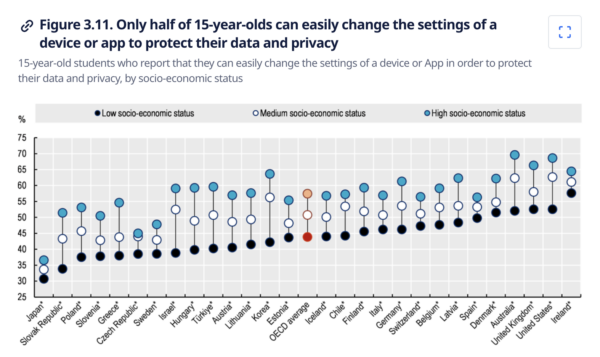
Source: OECD Data
And that’s where things start getting interesting, particularly from a cybersecurity perspective.
Because enforcing an age ban online doesn’t happen magically. Platforms somehow need to verify who users are. That means more digital ID systems, more age verification tools, more identity checks, and more personal data floating around the internet.
To stop teenagers from oversharing online, we may end up asking everyone to share even more information online.
That creates a whole new set of risks.
The risks of bans that require verifications
Every new verification system becomes another attractive target for cybercriminals. Identity databases are valuable. Extremely valuable. The more platforms collecting passports, facial scans, driver’s licences or biometric data, the larger the attack surface becomes.
And history tells us one thing with brutal consistency: if data exists, eventually someone will try to steal it.
That’s the awkward contradiction sitting at the centre of this debate. We are attempting to solve digital harms with even more digital infrastructure, while many everyday New Zealanders still don’t fully understand how their data is collected, stored or protected in the first place.
Parents are understandably worried about what social media is doing to children. But many adults are also being manipulated online daily by scams, misinformation, fake investment schemes, romance fraud and algorithm-driven outrage content.
Social media harms are not age-exclusive anymore. That’s why focusing purely on bans risks becoming political theatre rather than meaningful long-term protection.
Digital maturity is now as important as learning to drive or manage money
The reality is that technology is no longer something separate from life. It is life. School, banking, healthcare, communication, entertainment, shopping, employment and even government services are rapidly becoming digital-first experiences.
People are not growing up “online” anymore, they are growing up inside the internet.
That means the solution probably looks less like locking the gates and more like teaching people how to navigate the city safely.
Parents need support in understanding modern platforms. Schools need practical cybersecurity and digital literacy education that evolves with technology instead of lagging five years behind it. Young people need guidance on privacy, manipulation, online identity and algorithmic influence, not just warnings to “be careful online.”
None of this means governments should do nothing. Online harms are real, and pretending otherwise would be naive. But there’s a difference between appearing decisive and being effective.
Stay one step ahead
A social media ban makes for a strong headline. Education, digital resilience and cybersecurity awareness are slower, less glamorous and politically less exciting.
But they are also far more likely to survive contact with reality.
And reality, unfortunately, has Wi-Fi.
Cyber awareness will now, more than ever, be a part of everyday life. Stay one step ahead of the trends with our Cybersmart Newsletter and Webinars.
If you want to join our community dedicated to becoming more Cybersmart together, Follow us on Facebook